
Walking works for weight loss — not dramatically, but reliably. The CDC counts brisk walking as moderate-intensity exercise, and its baseline guideline is 150 minutes a week of exactly this. Below: why walking beats heroic workouts for most people, plus a realistic 8-week plan.
Key takeaways
- Brisk walking is moderate-intensity exercise per the CDC — 150 minutes/week of it meets the adult activity guideline.
- Walking wins on adherence: low injury risk, no gym, no recovery days needed, easy to stack onto an existing routine.
- The famous 10,000-step goal traces to a 1965 pedometer marketing campaign, not research — and a Harvard-led study found mortality benefits leveling off around 7,500 steps/day in older women. 7,000–8,000 daily steps is a solid target for most.
- Follow the 8-week progression below: start with 15–20 minute walks, add ~10% weekly, finish at 40–45 minutes most days.
- Walking supports weight loss best paired with a moderate calorie deficit — exercise alone rarely drives major loss.

Why walking beats heroic workouts for most people
The fitness industry sells intensity: HIIT, boot camps, “no pain no gain.” For weight loss, intensity is wildly overrated and consistency is everything. Here’s the honest comparison:
- Adherence. The best exercise is the one you’ll do 200 times. Walking has famously high adherence — no commute, no membership, no dreading leg day. A brutal workout you quit in week three burns fewer lifetime calories than boring walks you sustain for a year.
- Injury risk. High-intensity training injures beginners at meaningful rates; walking barely registers. An injury doesn’t just pause exercise — it often pauses the whole effort.
- Recovery and appetite. Hard workouts spike hunger in many people (hello, post-leg-day pizza), which can erase the calorie deficit they created. Walking’s appetite effect is gentler — some walkers even report reduced cravings.
- Compounding. Walking stacks onto life: commute walks, walking meetings, post-dinner loops. It doesn’t require carving a new 90-minute block from an already-full schedule.
- The math favors volume. A daily 40-minute brisk walk, sustained for a year, dwarfs three heroic months followed by nine sedentary ones. Weight loss is an area-under-the-curve game.
This isn’t anti-exercise snobbery — strength training twice a week is genuinely valuable (see our beginner’s strength guide). It’s about the cardio slot: for most people, that slot is best filled by walking.
What walking actually does for weight loss
Let’s be precise about the mechanism, because “walking burns fat” oversells it:
- Direct calorie burn is modest. A brisk hour-long walk burns a few hundred calories for a typical adult — meaningful, but one untracked restaurant meal erases several walks. Walking alone, without food changes, produces slow loss at best. The CDC is direct about this: lasting weight control needs both activity and eating changes.
- It protects the deficit. Walking improves insulin sensitivity, sleep quality, and mood — the three things that most often break diets. A good walk is often the difference between a controlled evening and a pantry raid.
- It preserves function while dieting. Combined with adequate protein and twice-weekly strength work, regular walking helps ensure the weight lost is fat, not muscle and fitness.
- NEAT matters. Non-exercise activity thermogenesis — the calories of daily movement — varies enormously between people and predicts weight maintenance better than formal workouts do. Walking is the most practical way to raise yours.
Bottom line: think of walking as the support system for your calorie deficit, not the deficit itself. It makes the deficit livable, sustainable, and healthier — which is exactly why it outperforms heroic exercise that nobody sustains.
Step targets: what the numbers really mean
Let’s clear up the most famous number in fitness: 10,000 steps. Harvard reports that its origin is unclear, but it may trace back to 1965, when a Japanese company began marketing a pedometer called the Manpo-kei — literally the “10,000-steps meter” — not a research finding. The actual evidence came later: Harvard epidemiologist I-Min Lee’s team studied 16,741 older women (average age 72, published in JAMA Internal Medicine, 2019) and found mortality benefits accruing from as few as ~4,400 steps/day and leveling off around 7,500 — well below 10,000. That’s a mortality study in older women, not a weight-loss prescription — but the shape of the finding is the point: the first few thousand steps do most of the work.
Practical targets by starting point:
| Your current average | Target for the next month | Notes |
|---|---|---|
| Under 3,000 steps/day | 5,000 | Just add one daily walk |
| 3,000–5,000 | 7,000 | The biggest health gains happen in this jump |
| 5,000–7,000 | 8,000–9,000 | Solid maintenance territory |
| 7,000+ | 9,000–10,000 | Fine if enjoyable; not required |
Two caveats. First, intensity matters too: 8,000 ambling steps aren’t equivalent to 8,000 brisk ones. The CDC’s guideline is 150 minutes/week of moderate-intensity activity — breathing noticeably faster but still able to hold a conversation; the CDC’s own example of brisk walking is a 15-minute mile. A step count plus a few brisk walks beats a high step count of pure shuffling. Second, don’t buy a tracker you won’t look at — phone step counters are free and sufficient. For more on building the surrounding routine, see our daily habits guide.
The 8-week walking plan
Assumptions: you’re cleared for moderate exercise (check with your doctor if you have heart disease, joint issues, or haven’t been active), you own supportive shoes, and “brisk” means you can talk but not sing. Warm up with 3–5 easy minutes; cool down the same way. One full rest day per week minimum.
| Week | Sessions | Duration | Focus |
|---|---|---|---|
| 1 | 3–4 | 15–20 min | Easy pace. Just build the habit — route, time of day, shoes. |
| 2 | 4 | 20 min | Settle into a rhythm. Same route is fine. |
| 3 | 4–5 | 25 min | Introduce “brisk” intervals: 2 min brisk / 3 min easy. |
| 4 | 5 | 25–30 min | Extend brisk intervals: 3 min brisk / 2 min easy. |
| 5 | 5 | 30–35 min | Mostly brisk. Add one route with gentle hills. |
| 6 | 5–6 | 35 min | Hills feel normal now. Notice your recovery improving. |
| 7 | 5–6 | 40 min | Add a “long walk” day: 50–60 min at conversational pace. |
| 8 | 5–6 | 40–45 min | You’re at ~200+ min/week — above the CDC baseline. Maintain or progress. |
Progression rules: increase weekly total time by no more than ~10%; if a week feels hard, repeat it — there’s no prize for rushing; soreness that alters your gait means you progressed too fast. After week 8, maintain 200–250 min/week, or add intensity (hills, intervals, longer long-walk) rather than endless duration.
Bad-weather backup: a treadmill, a mall, or marching in place during TV episodes all count. The plan survives winter only if you decide in advance what the indoor version is.
Speed, hills, and making walks harder
Once the habit is solid, intensity is the lever — not more hours:
- The talk test. Moderate intensity = you can talk in full sentences but couldn’t comfortably sing. If you can chat effortlessly, speed up; if you’re gasping, slow down.
- Hills. The single best upgrade. A hilly 30-minute walk can out-burn a flat 45-minute one, and hills build leg strength that flat walking doesn’t.
- Intervals. Alternate 2–3 minutes brisk with 2 minutes easy. Intervals raise average intensity without raising perceived misery much — the same trick that makes the week-3 transition work.
- Post-meal walks. A 10–15 minute easy walk after meals blunts blood-sugar spikes and aids digestion. It’s the highest-value 15 minutes in this entire article for people who sit all day.
- Weighted vests: proceed with caution. They increase burn but also joint stress. Keep any added weight modest (under ~10% of body weight), and skip them entirely with back, knee, or hip issues.
Walking + food: the combination that works
The classic failure mode: “I walked, so I earned the milkshake.” Exercise calories are easy to overestimate and easier to eat back. The combination that actually works:
- Set food targets independently of exercise. Your calorie deficit comes from food; walking is a bonus, not a license. Don’t “eat back” walk calories unless you’re losing faster than ~2 lbs/week.
- Protect protein. Walking plus a deficit plus low protein is how people lose muscle. Keep protein at 1.2–1.6 g/kg.
- Time walks strategically. Post-dinner walks directly attack the highest-risk eating window of the day — you’re walking instead of snacking, which doubles the benefit.
- Sleep feeds the cycle. Better sleep → better food choices → more energy to walk → better sleep. Walking improves sleep quality, which improves everything downstream.
Gear and practicalities
Keep this short — gear is the least important part:
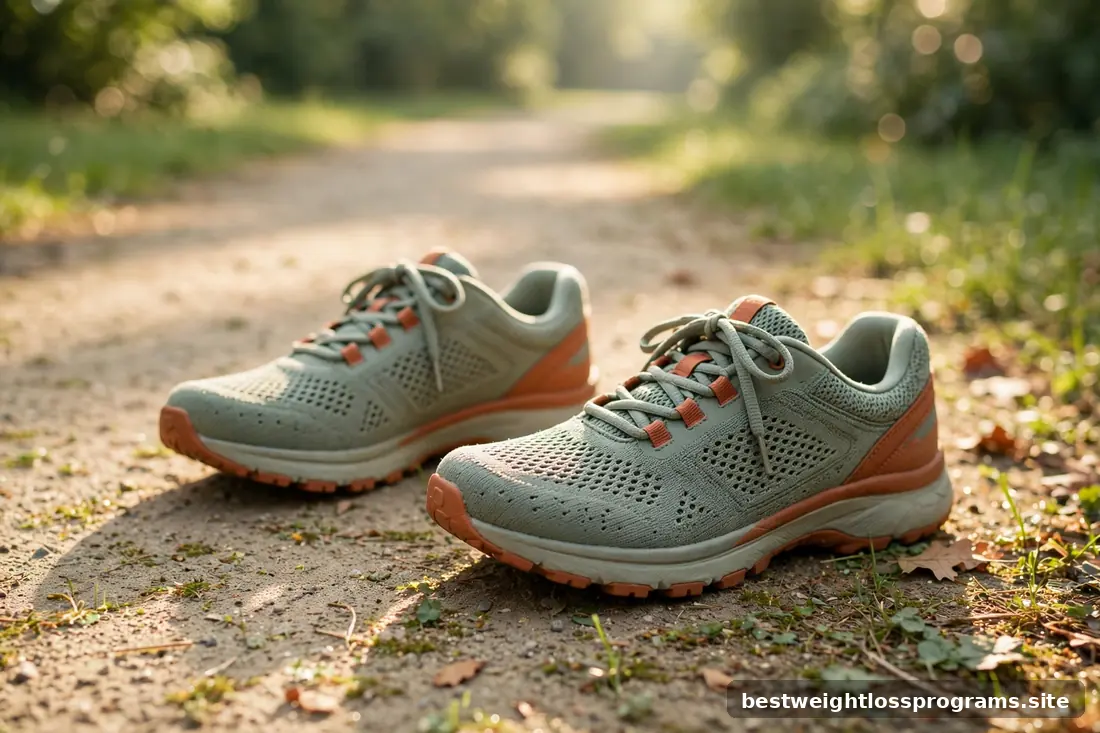
- Shoes are the one thing that matters. Supportive, broken-in walking shoes or sneakers. Blisters and shin splints kill more walking plans than motivation ever does; most trace back to footwear.
- Safety. Walk facing traffic where there are no sidewalks, carry a light after dark, and choose routes where you feel safe — an unsafe route is a plan that ends.
- Weather. Layers, a rain shell, and the indoor backup plan from week 1. “Too cold” is usually a clothing problem, not a weather problem — down to the point where ice makes it genuinely unsafe.
- Everything else is optional. Fancy trackers, walking poles, special socks — nice if you enjoy them, irrelevant if you don’t. The cheapest healthy approach needs nothing but shoes.
Frequently asked questions
How much walking do I need to lose weight?
Walking supports weight loss rather than driving it — pair 150–200+ minutes/week of brisk walking with a moderate calorie deficit (about 500/day) for roughly a pound a week. Walking without food changes produces slow, modest loss at best.
Is walking better than running for weight loss?
For most beginners, yes — not because walking burns more (it doesn’t, per minute), but because you’ll actually do it consistently without injury. A runner who trains consistently beats a walker; a walker beats a runner who quit in February.
Can I lose belly fat specifically by walking?
No exercise targets fat from specific areas — spot reduction is a myth. Walking in a calorie deficit reduces overall body fat, which includes abdominal fat over time.
What if I can’t walk 30 minutes yet?
Start with 10-minute walks, 2–3 times a day — the CDC’s guideline counts accumulated bouts. Three 10-minute walks equal one 30-minute walk for the weekly total. Start where you are; the plan’s week 1 is a suggestion, not a law.
The bottom line
Walking won’t transform you in 30 days, and that’s precisely the point. It’s free, joint-friendly, endlessly sustainable, and it makes every other part of weight loss — the food, the sleep, the mood — work better. Build to 150–200 brisk minutes a week, pair it with a moderate deficit and enough protein, and you’ve assembled the most boringly effective exercise plan in existence.
Boring is the feature. Boring is what still works in year two.
This is general information, not medical advice — talk to your doctor before starting any weight loss program.