
Willpower is a terrible weight loss strategy: it is a finite daily resource, and life spends it before dinner. The people who keep weight off long-term do not have more discipline; they have better systems. These nine daily habits are small, evidence-linked, and designed to run on autopilot — no motivation required.
Key takeaways
- Habits beat willpower because they run on cues and repetition, not daily motivation.
- The highest-leverage habits: track food, walk daily, eat protein and vegetables, cut sugary drinks, sleep 7+ hours.
- Install one habit at a time, anchored to something you already do — never overhaul everything on Monday.
- A habit that survives a bad week is better than a perfect routine that survives two.
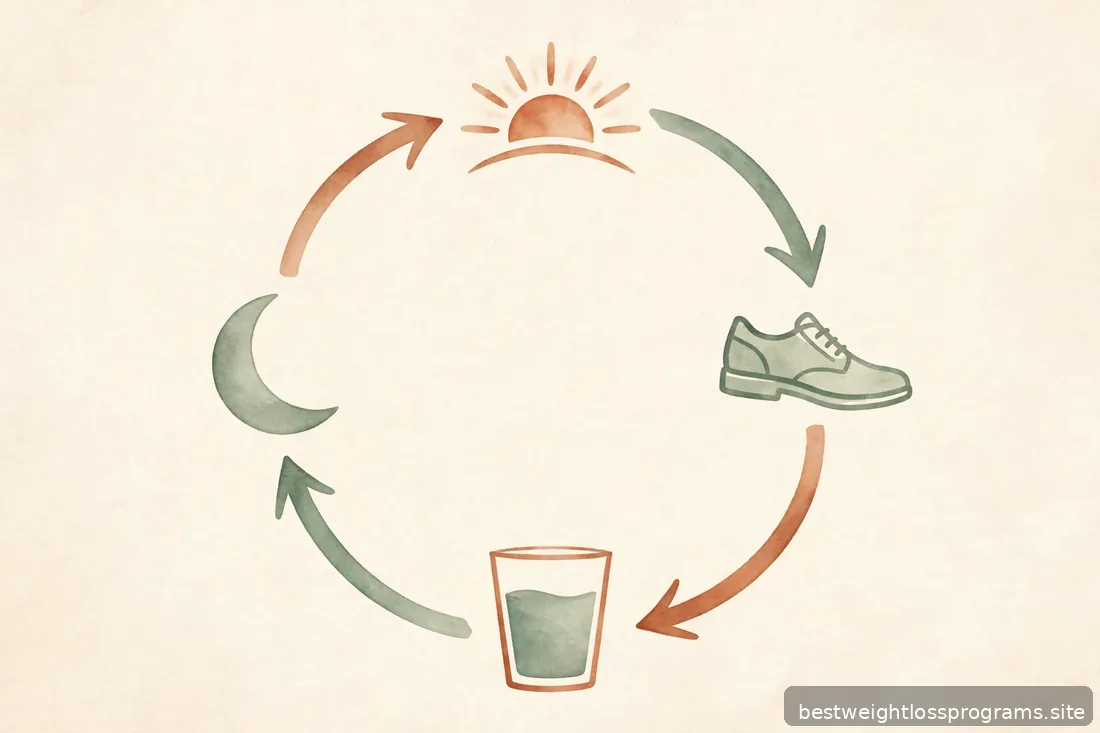
Why habits beat willpower
Every diet you have ever quit failed the same way: it required a fresh decision, made with full motivation, several times a day, indefinitely. That is not a plan; that is a hostage negotiation with your future tired self. Research on behavior change consistently finds that self-monitoring and structured routines predict weight loss maintenance far better than motivation levels do. Motivation gets you started. Systems keep you going.
A habit, in the practical sense, is a behavior tied to a cue: after I pour my morning coffee, I step on the scale; after dinner, I walk for 15 minutes. The cue does the remembering, so your decision-making energy stays untouched. This is why the habits below are deliberately small. A 10-minute walk you actually do beats a 60-minute workout you skip. The CDC’s weight loss guidance makes the same point in official language — lasting weight management comes from sustainable lifestyle patterns: healthy eating, regular activity, enough sleep, and stress management — not from heroic short-term efforts. (CDC)
One more framing note: none of these habits is magic alone. Their power is cumulative and compounding. Each one removes a little friction or a few dozen calories from the day, and together they quietly reshape what “a normal day” looks like.
Habit 1: Track what you eat (honestly, briefly)
Of all weight loss behaviors studied, self-monitoring — writing down what you eat — has one of the strongest track records. It works for an unglamorous reason: most people underestimate their intake by a wide margin, and the act of recording closes that gap. You do not need a perfect calorie count. A quick photo log or a few lines in a notes app is enough to make the invisible visible.
The rule that makes tracking sustainable: record before you eat when possible, and never use the log as a courtroom. A skipped day is data, not failure — just start again at the next meal. If detailed tracking triggers anxiety or disordered patterns for you, skip this habit entirely and lean on the others; no single habit is worth your mental health.
Habit 2: Walk after meals
A short post-meal walk is the highest return-on-effort movement habit in existence. Ten to fifteen minutes of easy walking after your biggest meal aids digestion, steadies energy, and adds meaningful daily activity without requiring workout clothes, a gym, or motivation. It also breaks the couch-to-kitchen loop where most evening snacking happens.
Anchor it: after I clear the dinner table, I walk around the block. Rainy day? March in place or pace the hallway for 10 minutes. The CDC notes that adults need at least 150 minutes of moderate aerobic activity weekly — and that it can be broken into small chunks across the week. (CDC activity guidelines) Post-meal walks are how busy people accumulate those minutes without “exercising.” For a fuller structure, build up gradually with daily walks you actually enjoy.
Habit 3: Put protein on every plate
Protein is the most satiating macronutrient — meals built around it keep you fuller longer than equal-calorie meals built around refined carbs. It also supplies the raw material your muscles need, which matters doubly if you are strength training while losing weight.
The habit is structural, not numerical: every meal and snack gets a palm-sized protein source. Eggs or Greek yogurt at breakfast, chicken/fish/beans/tofu at lunch and dinner, a handful of nuts or cottage cheese for snacks. You do not need to hit a gram target on day one; the plate habit gets you most of the benefit. For specific numbers, standard protein guides break down realistic targets for active people.
Habit 4: Fill half your plate with vegetables
This is portion control without counting. Vegetables deliver volume, fiber, and micronutrients for very few calories, so a half-plate of them physically crowds out the calorie-dense foods while leaving you satisfied. It works at restaurants, buffets, and family dinners — anywhere calorie math is impossible.
Practical version: keep frozen vegetables stocked (nutritionally equivalent to fresh, zero prep guilt), and learn two preparations you actually like — roasted with olive oil and salt, or stir-fried with garlic. A habit you dread is a habit you abandon; palatability is a feature, not a compromise.
Habit 5: Drink water instead of sugary drinks
Sugary drinks are the easiest calories to cut because they barely register as food. A single daily soda or sweetened coffee drink can carry 150–300 calories that do almost nothing for fullness — and the CDC is blunt that reaching and maintaining a healthy weight requires adjusting “the number of calories you eat and drink.” (CDC)
The habit: make water the default and sugary drinks the exception. Keep a water bottle where you will actually see it (desk, car, nightstand). If plain water bores you, sparkling water with lemon counts. You do not need to quit your Friday milkshake; you need to stop the daily 250-calorie drink you barely notice. That one change alone is a meaningful fraction of the calorie deficit most people need.
Habit 6: Protect your sleep window
This habit earned its place through biochemistry, not folk wisdom. As we covered in our sleep and weight loss guide, short sleep measurably disrupts the hunger hormones leptin and ghrelin — less sleep means more hunger and weaker fullness signals the next day. Protecting 7+ hours of sleep is appetite control that happens while you are unconscious.
The habit version: a non-negotiable bedtime alarm — not a wake alarm, a go-to-bed alarm. Set it for 30 minutes before lights-out, and treat it like a meeting with someone important. Screens off, wind-down on. Everything else about sleep hygiene is optimization; the protected window is the foundation.

Habit 7: Plan tomorrow’s food tonight
Most unplanned eating is not hunger — it is decision fatigue meeting an empty plan. Spending five minutes each evening deciding tomorrow’s breakfast, lunch, and one snack eliminates dozens of vulnerable micro-decisions. This is the habit version of meal prep for people who will never spend Sunday batch-cooking.
Keep it low-effort: a sticky note on the fridge, a recurring phone reminder, or a line in your food log. The plan does not need to be perfect or even healthy every day — a decided mediocre lunch beats an undecided afternoon that ends at the drive-through. Decide when your brain is fresh; execute when it is not.
Habit 8: Weigh in weekly, not daily
Daily weigh-ins turn normal water fluctuations into emotional events. Weekly weigh-ins — same day, same time, same conditions — give you a trend line without the noise. And the trend is the only thing that matters: weight loss is not linear, and a single week’s number is mostly water, glycogen, and timing.
The habit: every Wednesday morning (pick your day), weigh, log it in one place, and move on. Compare four-week averages, not week-to-week jumps. If the scale trends the wrong way for three weeks running, that is a signal to adjust the plan — calmly, like an engineer, not like a judge. Pair this with a realistic sense of healthy rates of weight loss so your expectations match reality.
Habit 9: Build a 5-minute stress reset
The CDC lists stress management as a pillar of healthy weight loss for a reason: chronic stress drives cortisol, disrupts sleep, and reliably steers people toward calorie-dense comfort food. You cannot eliminate stress, but you can build a circuit breaker between the stressful moment and the kitchen.
Pick one 5-minute reset and anchor it to your hardest hour: a short walk around the block, box breathing (4 counts in, 4 hold, 4 out, 4 hold), stretching, or stepping outside for fresh air. The content matters less than the pattern — stressed → reset → then decide about food. Most stress eating is not a food problem; it is an unprocessed-emotion problem wearing a food costume.
How to install habits without burning out
Reading nine habits and attempting all nine on Monday is how you end up with zero habits by Friday. Install them like software updates — one at a time:
- Pick the easiest one first. Early wins build the identity of “someone who follows through.” Post-meal walks or the water swap are good starters.
- Anchor it to an existing cue. After [something you already do daily], I will [the habit]. Write the sentence down. “After I brush my teeth at night, I set out tomorrow’s breakfast” beats “I should plan better.”
- Shrink it until it is stupid-easy. The habit is “walk 5 minutes after dinner,” not 30. You can expand later; you cannot expand a habit you quit.
- Track the streak, forgive the breaks. A wall calendar with X marks is enough. Miss a day? The rule is never miss twice — one miss is life, two is a new pattern.
- Add the next habit only when the current one feels automatic — usually 2–4 weeks. Nine habits installed over six months beat nine habits attempted in one week, every time.
Expect plateaus, bad weeks, travel, holidays, and illness. The system is not broken when life interrupts it; the system is working when you return to it without drama. That return — quiet, unheroic, repeated — is the entire difference between people who lose weight and people who keep it off.
Frequently asked questions
Which habit matters most?
If forced to rank: tracking food and daily walking have the strongest evidence base, with sleep close behind. But the best habit is the one you will actually do for a year. Start where your life has room.
How long until habits feel automatic?
Longer than the popular “21 days” myth suggests — research on habit formation finds wide variation, often around two months of consistent repetition, with simpler habits locking in faster. Plan for 8 weeks, celebrate earlier if it clicks.
Do I need to do all nine?
No. Five solid habits beat nine shaky ones. These are a menu, not a prescription — pick the ones that fit your life and ignore the rest without guilt.
What if I fall off for a whole month?
Then you are a normal human with a disrupted routine, not a failure. Restart with one habit — the easiest one — and rebuild. The habits do not expire.
This is general information, not medical advice — talk to your doctor before starting any weight loss program.