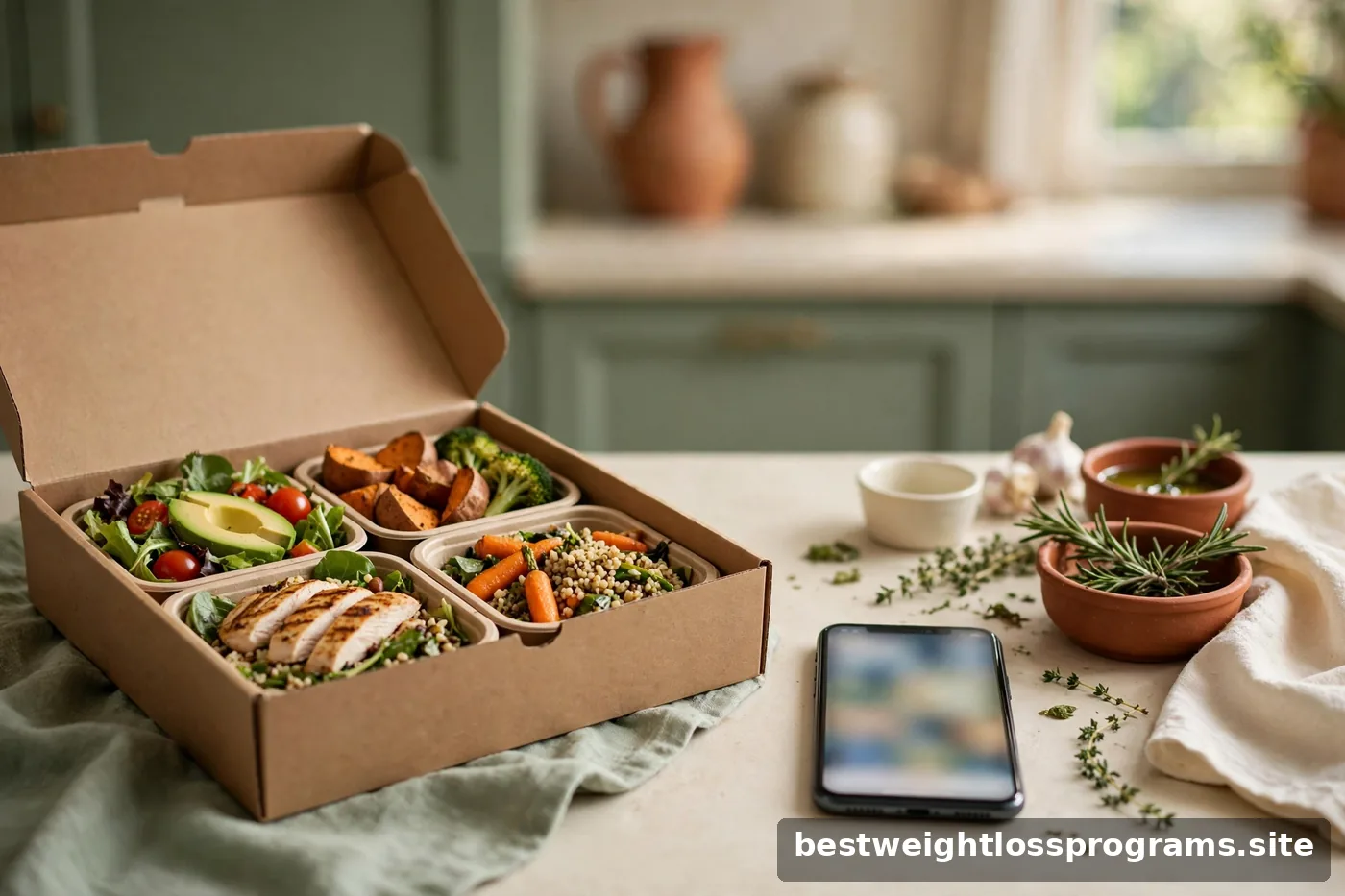
Meal delivery weight-loss programs cost roughly $3,600–$6,000 in the first year once you include groceries and shipping; app-based programs cost roughly $120–$540 for the membership plus your normal grocery bill. Delivery wins on effort — zero planning, zero portioning — while apps win on cost, food freedom, and teaching you to maintain. The honest answer: delivery rents you structure, apps try to teach it to you.
Key takeaways
- First-year all-in cost: meal delivery ≈ $3,600–$6,000; app programs ≈ $120–$540 in membership fees plus groceries you’d buy anyway.
- Meal delivery’s advertised price excludes groceries for “flex meals” (~$80–$100/month) and sometimes shipping — always add those before comparing.
- Delivery eliminates decision fatigue but teaches little about feeding yourself; apps demand daily effort but build transferable skills.
- A common winning sequence: delivery for initial structure, then an app program to learn maintenance — if your budget allows both phases.

The true first-year cost math
Marketing compares headline rates. Let’s compare what leaves your bank account.
Meal delivery: the full stack
Take a popular Nutrisystem-style plan as the example. The plan price you see advertised (roughly $280–$400/month depending on tier and commitment) is the beginning of the math:
| Cost layer | Typical monthly amount |
|---|---|
| Plan meals (28-day supply) | $280–$400 |
| Shipping (where not included) | $0–$15 |
| Groceries for flex meals and add-ons | $80–$100 |
| All-in monthly total | ~$360–$515 |
| First-year all-in | ~$4,300–$6,200 |
Note what’s not in that number: the food anyone else in your household eats. If you’re feeding a family too, delivery is an add-on to a normal grocery bill, not a replacement for it.
App-based programs: the full stack
Now the same math for WW or Noom:
| Cost layer | Typical monthly amount |
|---|---|
| Membership (annual plan or promo rate) | $10–$30 |
| Groceries | What you’d spend anyway (not program-caused) |
| Optional: workshops/dietitian tier | +$10–$25 |
| Membership first-year total | ~$120–$540 |
The grocery line is the key philosophical difference: with app programs, you were going to buy groceries regardless. The program doesn’t add a food bill; it changes what’s in the cart. With delivery, the food bill is new spending on top of baseline groceries (unless you genuinely replace all eating with shipped meals, which almost nobody does for a full year).
The ratio
Put bluntly: meal delivery costs roughly 10–20x what an app program costs per month, and the gap compounds — a two-year delivery run can exceed $10,000 all-in, while two years of app coaching stays under $1,100 in membership fees. Delivery has to be dramatically better at keeping you compliant to justify that multiple. For some people it is. For most, the math favors the app — if they’ll actually use it.
For the complete price tables across all program types, see How Much Do Weight Loss Programs Cost? (2026 Price Guide). If the delivery math rules it out for you, The Cheapest Healthy Ways to Lose Weight shows what the $0–$25/month path actually looks like.
What the money actually buys
With delivery, you buy the absence of decisions. No meal planning, no grocery lists for diet food, no portioning, no “what’s for dinner” negotiation with yourself at 6pm when willpower is lowest. For people whose previous attempts died in the planning phase — not the eating phase — this is the product working as intended. You’re outsourcing executive function, and executive function is expensive.
With apps, you buy structure plus education. WW’s Points system teaches portion awareness; Noom’s lessons teach habit mechanics; both include tracking, coaching, and community. What you’re not buying is food — you still shop and cook, which means you still face every decision delivery removes.
Here’s the uncomfortable question delivery marketing never asks: is decision fatigue your actual problem, or is it a story you tell about a different problem? If you’ve repeatedly failed at the eating part (portions, snacking, weekends), pre-portioned meals address it directly. If you’ve failed at the consistency part (sticking with anything past month two), delivery just moves the quitting point — people quit delivery too, usually over cost or food fatigue, and then face the same consistency problem with less money.
The effort trade-off
| Meal delivery | App-based program | |
|---|---|---|
| Daily food decisions | Near zero | Constant (what, how much, when) |
| Cooking | Minimal (heat and eat) | You cook (or assemble) everything |
| Logging/tracking | Light (meals are pre-logged) | 10–20 min/day of logging |
| Learning curve | Days | Weeks (learning the system) |
| Social eating friction | High (your food vs. their food) | Low (program adapts to restaurants) |
| Travel friction | High (shipments, routine breaks) | Low (app travels with you) |
| Exit/transition effort | High (must learn to self-feed) | Low (you were self-feeding all along) |
Two rows deserve emphasis. Social eating: delivery works best for people whose meals are mostly solo and routine; it fights back against frequent restaurants, dinner parties, and travel. Apps bend — WW has a restaurant database precisely because real life includes restaurants.
The exit: this is delivery’s weakest row and the industry’s least-discussed topic. At some point you stop paying $400+/month and start feeding yourself. Programs offer “transition” guidance, but learning to plan, portion, and cook after months of not doing it is a genuine second project. App users never stopped doing those things — maintenance is a continuation, not a new skill.

Results and maintenance
Anyone selling you a head-to-head “which loses more weight” number is selling you something. Weight loss comes from a sustained calorie deficit, and both approaches can create one. What differs is adherence architecture:
- Delivery front-loads adherence. Compliance is highest in months 1–3 (the food just arrives), then decays as food fatigue and cost fatigue set in. It produces good short-term structure for people who need a reset.
- Apps back-load adherence. The first month is the hardest (learning the system while changing habits), but users who survive it have built transferable skills — which is exactly what maintenance requires.
The CDC’s guidance cuts across both: gradual loss of about 1–2 pounds per week, with lifestyle fundamentals (eating patterns, activity, sleep, stress) doing the long-term work. Neither delivery boxes nor app badges change that. And modest loss — even 5% of body weight — measurably improves blood pressure, cholesterol, and blood sugar, whichever route gets you there.
The maintenance question to ask any program: “What specifically does month 13 look like?” Good answers describe a maintenance phase, calorie/Points recalibration, and ongoing accountability options. Vague answers (“you’ll have learned healthy habits!”) are a red flag regardless of lane.
The hybrid approach
The highest-value play for many people isn’t either/or — it’s sequential:
- Months 1–3: delivery for structure. Use the pre-portioned phase to break old patterns, learn portion sizes visually, and get early momentum without decision fatigue. Treat it explicitly as training wheels.
- Months 4–12: app program for skill-building. Transition to WW, Noom, or even a free tracker while the portion instincts are fresh. Now you’re learning to produce the same results with your own cooking.
- Year 2+: tracker or nothing. Maintain with the lightest tool that keeps you accountable.
This costs more than apps alone but far less than delivery indefinitely — roughly $1,500–$2,500 for the full first year versus $4,300–$6,200 for delivery all year. It also directly attacks delivery’s weakest row (the exit) by planning the transition from day one.
The hybrid fails when phase 1 becomes permanent — which is exactly what the delivery company’s business model hopes for. Set the transition date before you order the first box.
FAQ
Is meal delivery worth it for weight loss?
It can be, for the right person: someone whose main barrier is food decisions (not consistency), who can afford $400+/month for many months, and who has a real transition plan. It’s not worth it as an indefinite subscription — the cost compounds and the food fatigue is real.
Why is meal delivery so much more expensive than apps?
You’re buying manufactured, portioned, shipped food plus the program — that’s a supply chain, not software. Apps sell software and coaching, which scale cheaply. Neither price is a rip-off; they’re different products with different cost structures.
Can I do delivery short-term just to learn portions?
Yes — this is one of the smartest uses of it. A 1–3 month run teaches visual portion sizes effectively. Just confirm the cancellation terms before ordering (some plans require a phone call to cancel and charge early-termination fees on prepaid commitments).
Do app programs work if I hate cooking?
They work less well, honestly. App programs assume you feed yourself. If you truly won’t cook, delivery or a “healthy takeout + tracker” combo fits better than an app program whose meal plans you’ll never make. Match the program to your actual kitchen behavior, not your aspirational one.
What about grocery costs on app programs — don’t they go up?
Usually modestly or not at all. Protein, produce, and whole grains can cost more than ultra-processed food per calorie, but you’re replacing restaurant meals and impulse purchases too. Most people find the grocery bill roughly flat — the membership fee is the new spending, and it’s small.
What does a realistic monthly food budget look like on each?
On delivery: the plan itself ($280–$400) plus $80–$100 in groceries for flex meals — call it $400–$500 all-in for one person, before feeding anyone else in the household. On apps: your normal grocery bill, which for most households already runs a few hundred dollars per person monthly, plus the $10–$30 membership. The uncomfortable truth is that delivery rarely replaces your grocery spending — it stacks on top of it — which makes the true gap between the lanes even wider than the membership prices suggest.
Sources checked for this article: Noom’s official 2026 pricing page, WeightWatchers plan and pricing details via weightwatchers.com (promotional rates as listed September 2026 — verify current pricing on the official site), and the CDC’s Steps for Losing Weight. Meal-delivery figures reflect currently listed plan ranges plus typical grocery add-on spending; confirm on the provider’s official pricing page before purchasing.
This is general information, not medical advice — talk to your doctor before starting any weight loss program.